
In this guide, you’ll learn the updated 2026 concepts of Interlinks In SEO, including benefits, structure, strategy, Google’s latest link evaluation system, and how link placement affects page authority.
Internal linking is one of the most important parts of SEO because it helps search engines understand your website structure, discover important pages, and transfer authority between related pages. A proper interlinking strategy also improves user experience by guiding visitors toward relevant content, services, and solutions.
What are Interlinks In SEO?
Interlinks In SEO are hyperlinks that connect one page of a website to another page within the same domain. These links help users navigate related content and help search engines understand the relationship between pages. Internal links create a clear website structure that allows Google to discover important pages faster and understand as we Discussed All concepts as Below.
Benefits of Internal Linking

Help to Build Structure of Website
Internal linking helps create a proper structure for your website by connecting related pages in a meaningful way. It allows search engines to understand how pages are organized and which topics are connected to each other. A well-structured website improves crawlability and user navigation. When pages are properly interlinked, Google can discover content faster and understand the hierarchy of your website more effectively. This also helps users easily move between relevant pages and spend more time on your site.

Set up the Priority of Page
Internal links help search engines identify which pages are most important on your website. When multiple pages link to a specific page, Google understands that the page has higher value and relevance. This helps improve the ranking potential of important pages such as service pages, category pages, and pillar content. Strategic internal linking distributes authority across the website and strengthens pages that are important for SEO and conversions.

Help in Canonical Page
Internal linking supports canonical pages by consistently directing authority and relevance toward the preferred version of a page. When multiple related pages internally link to one primary page, Google better understands which page should be treated as the main source of information. This reduces confusion between similar pages and helps consolidate ranking signals. Proper internal linking also improves indexing efficiency and strengthens the visibility of the main page in search results.
Internal Linking Strategy
A strong internal linking strategy should focus on relevance, hierarchy, and user experience. Every link should connect related content naturally and help users discover valuable information. Important pages should receive more contextual links from relevant content pages.
The best strategy is to create a clear topical structure where supporting pages connect to pillar pages and service pages. This improves authority flow and helps search engines understand topic depth. Contextual links placed naturally within the main content area usually pass more SEO value than links placed in sidebars or footers.
Perfect Structure of Interlink For Commercial Portfolio
Home Page → Pillar Page → All Content Page → Service Page
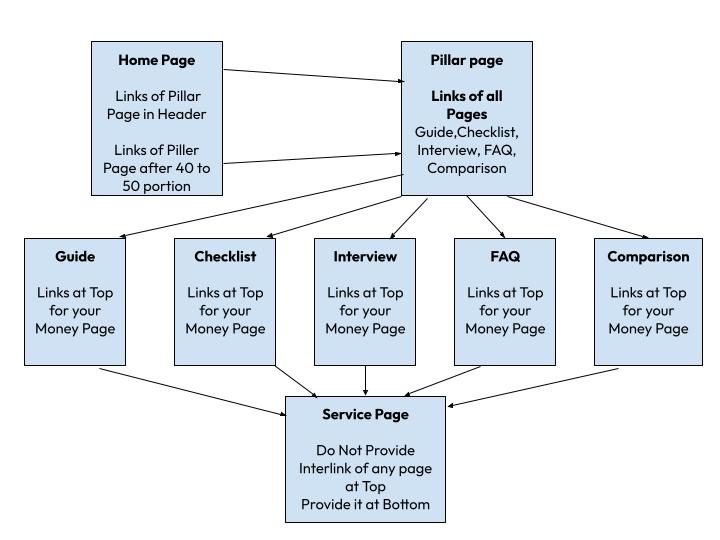
This is one of the best internal linking structures for commercial websites because it creates a clear SEO hierarchy.
The Home Page should link to major pillar pages that represent the core topics or services of the business. Pillar pages should then connect to all related content pages such as blogs, guides, and informational articles. These content pages should strategically link to relevant service pages where conversions happen.
This structure helps Google understand the relationship between informational and commercial content. It also distributes authority from high-level pages toward important service pages. Users can easily navigate from general information to detailed content and finally to conversion-focused pages. This improves crawlability, topical authority, rankings, and user experience together.
What should you Ignore
Ignore to place the Links in Secondary Content
Avoid placing important internal links inside secondary content areas like sidebars, widgets, author boxes, or unnecessary sections. These areas usually receive lower user attention and may pass less SEO value. Contextual links inside the main content are generally more powerful because users naturally engage with them more frequently.
Ignore to Place the Links in Below Part of Content
Avoid placing your most important internal links only at the bottom of the content. Users may not always scroll to the end of the page, and Google gives more importance to links placed higher in the main content. Early contextual links usually carry stronger relevance and authority signals.
Do not Interlinks to all your pages with each other
Do not connect every page randomly with all other pages. Excessive interlinking can confuse search engines about which pages are truly important. Instead, create a logical structure where links are added based on topic relevance, hierarchy, and page importance. Strategic linking creates better SEO signals and cleaner website architecture.
What should you Do
Place the Interlink at the main and Top part of the Content
Place important internal links naturally within the top section and main body of the content. Links placed early in the article usually receive higher user engagement and stronger SEO value. Contextual links near relevant information help search engines better understand page relationships and improve authority transfer.
Do Interlinks to all your pages with in Sequence based on the Importance
Create internal links in a proper sequence according to page importance and topic relevance. Important pages should receive more contextual links from related content. This creates a clear hierarchy that helps Google understand which pages deserve more authority, visibility, and ranking strength across the website.
Google’s System for Evaluating Internal Links
Random Links Search (Old Version)
In the earlier version of Google’s PageRank system, search engines followed a concept called the “Random Surfer Model.” Under this model, Google treated most links on a page almost equally. Whether a link was placed in the header, sidebar, footer, or content body, it could pass similar value.
Google crawled almost every available link on the page and distributed authority across all linked pages. Because of this, many websites heavily used footer links, sidebar links, and sitewide navigation links to transfer ranking power. However, this often created poor user experience and unnatural website structures. Over time, Google improved this system to better reflect real user behavior and link importance.
Reasonable Links Search (New Version)
Google later introduced the “Reasonable Surfer Model,” which focuses on how real users interact with links. In this updated system, Google gives more importance to links that users are more likely to click. Contextual links placed naturally inside the main content area usually carry higher SEO value than links placed in sidebars, footers, or repetitive navigation sections.
Google understands that users pay more attention to links placed within useful and relevant content. Because of this, internal links inside the main content pass stronger authority and contextual relevance. This system helps Google better evaluate page importance, user behavior, and topical relationships between pages.
Link Juice Transfer from Top to Bottom
Link juice refers to the authority or ranking value passed from one page to another through internal links. In modern SEO, link placement affects how much authority is transferred. Links placed at the top section of the main content generally pass stronger value because users are more likely to notice and click them.
As links move lower on the page, their importance may gradually decline because user engagement decreases toward the bottom sections. Footer links and secondary links usually transfer less authority compared to contextual links placed naturally inside the primary content area.
This is why SEO experts prefer placing important internal links near the beginning of relevant content. Strategic placement helps improve page authority flow, crawl efficiency, and ranking performance across the website.