
Quick Key Takeaways:

Google uses 17+ background ranking systems (like BERT, MUM, PageRank) rather than a single algorithm.
Systems like Passage Ranking and Deduplication automatically refine search visibility without requiring manual site changes.
Modern search success depends on E-E-A-T, intent matching, and clear technical site health.
Achieving a top position on the Search Engine Results Pages (SERPs) relies entirely on understanding how the Google Search ranking algorithm evaluates web pages. This comprehensive breakdown decodes every critical system driving organic search visibility today.
What is the Google Search Ranking Algorithm?
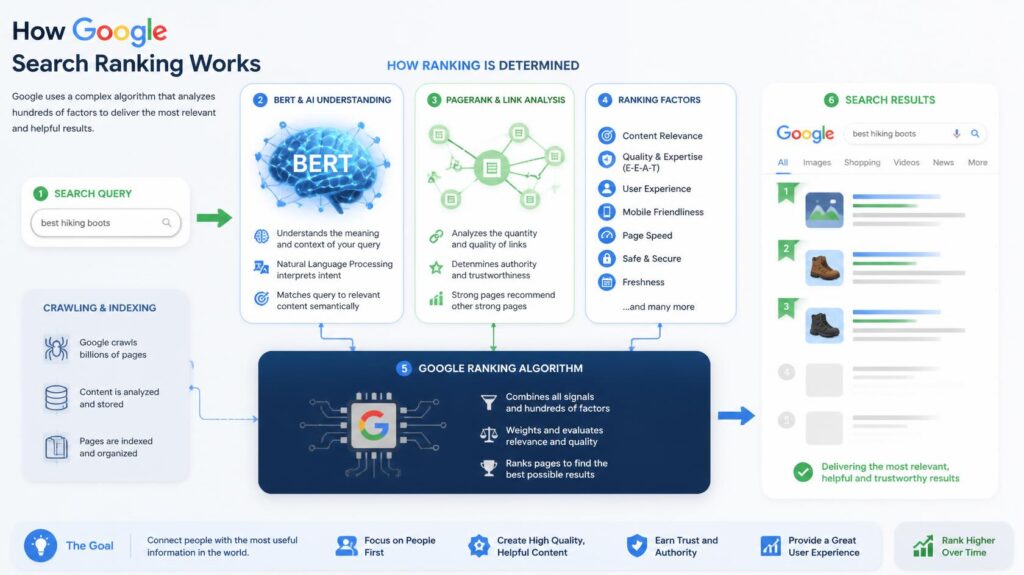
The Google Search ranking algorithm is a complex matrix of automated background systems used to calculate website relevance. It dynamically assesses specific quality signals to deliver the most accurate, helpful search results for target user keywords.
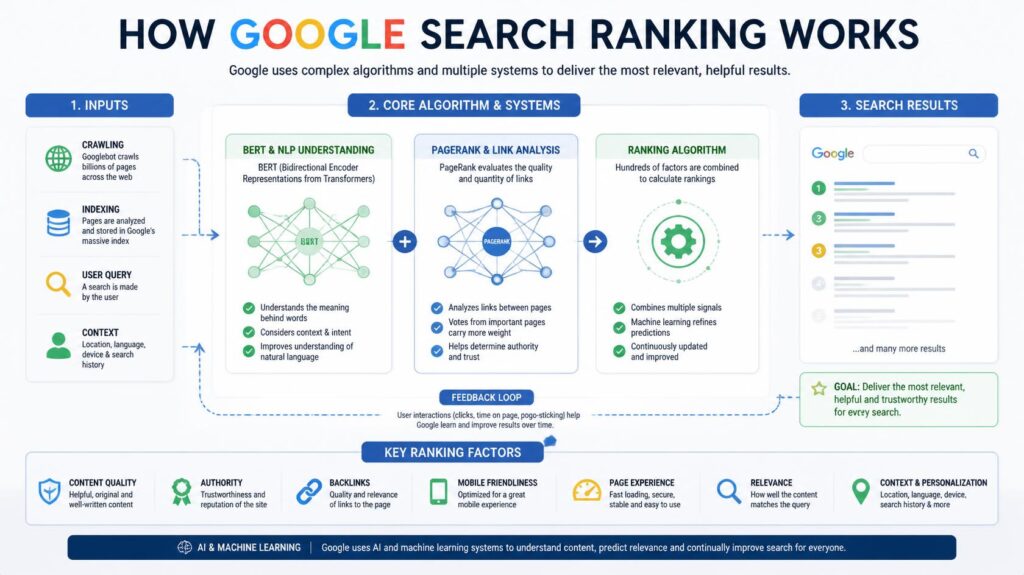
Major Google Search Ranking Systems & Their Role in SEO
The following automated ranking systems operate continuously in the background to evaluate and sort online content.
1. BERT (Bidirectional Encoder Representations from Transformers)
An AI-driven framework that enables Google to interpret natural language processing, context, and semantic intent behind complex queries. While introduced as a research model in late 2018, it rolled out globally across Google Search in October 2019 to better match web content with human user expectations.
Practical Implication

Before BERT
Search engines ignored the word “to” and incorrectly showed US visa requirements for Americans traveling to Brazil.

With BERT
The system recognized that “to” meant the direction of travel, correctly displaying US visa guidelines for Brazilian citizens.
2. Crisis Information Systems
This safety-focused matrix dynamically surfaces highly authoritative information during crucial events, splitting operations into personal safety and global tracking.

Personal Crisis
Triggers when search queries indicate harmful intent (such as self-harm or violence), prioritizing helpline hotlines and trusted medical support content over standard organic results.

SOS Crisis
Automatically activates during sudden natural disasters or public emergencies, highlighting real-time security alerts, evacuation maps, and official local governmental updates.
3. Deduplication Systems
Designed to clean up the SERPs by ensuring unique, non-repetitive results for a more useful browsing experience.
System A
It guarantees a domain typically appears only once per standard organic results list while filtering out copycat text to reward the genuine original source.
System B
Fact Check: While many believe Google passes a copycat’s backlinks directly to you, the system actually filters the stolen version out of search visibility to preserve your original piece.
Practical Implication : If your article earns the Featured Snippet (Position 0) for “Best SEO Checklist”, Google removes your standard blue link from Page 1 so your website doesn’t appear twice on the same page.

System C
Fact Check: Schema markup enhances your snippet and doesn’t hide organic links; however, if your content earns a Featured Snippet, Google deduplicates the page by removing its standard blue link from page one.
4. Exact Match Domain (EMD) System
Prevents low-quality websites from ranking highly strictly because their domain name matches a popular search query. It forces domains to earn authority via real utility, value, and robust backlink structures instead of clever naming.
Practical Implication
Buying a domain name like [www.buybestlaptops.com](https://www.buybestlaptops.com) will not automatically rank you #1 for “buy best laptops”. Unless the site offers real value and strong backlinks, authoritative sites like Amazon will continue to rank higher.
5. Freshness Systems
Prioritizes the latest, up-to-the-minute content for time-sensitive search intents. This applies specifically to breaking news, trending public topics, stock market shifts, or local weather reports.
Practical Implication
For search queries like “IPL Live Score” or “Breaking News”, the Freshness System ranks a article published 2 minutes ago above a 2-year-old authority page.
6. Link Analysis Systems and PageRank
Google’s foundational mechanism evaluating how websites link to one another to determine topic authority. It calculates backlink quality, relevance, and link placement context to establish a web page’s structural authority score.
Practical Implication
Getting a single backlink from an authoritative source like Forbes holds significantly more weight and ranking power than getting 50 backlinks from new, low-authority blogs.
7. Local News Systems
A situational ranking layer that amplifies localized news organizations during specific regional incidents. It ensures nearby searchers instantly receive geographically relevant updates over broad national outlets.
Practical Implication
If a road closure or major event happens in your city, searching for it will highlight local regional news websites over national media outlets to give you immediate, relevant updates.
SOURCE : A Guide to Google Search Ranking Systems
8. MUM (Multitask Unified Model)
A multimodal AI system engineered to process complex information across multiple languages, text formats, and imagery. Currently, it enhances featured snippet explanations and refines specific search answers without altering core organic structures.
Practical Implication
Search Query: “I have hiked Mt. Fuji, now I want to hike Mt. McKinley, what should I prepare differently?”
MUM analyzes elevation data, weather reports, and equipment guides across multiple languages to combine everything into a single, direct answer
9. Neural Matching
A conceptual retrieval system allowing Google to understand synonyms and broader concepts. It accurately connects query intents to highly relevant pages, even if the exact words are missing from the text.
Practical Implication
Search Query: “why does my TV look like water paint”
Even if a webpage doesn’t mention “water paint,” Neural Matching understands the underlying concept and ranks pages explaining how to turn off the “TV Motion Smoothing / Soap Opera Effect.”
10. Original Content Systems
Ensures that creators who break stories or publish unique research receive primary visibility. It rewards genuine journalism by prioritizing original sources over content that merely cites or rehashes them.
Source: A Guide to Google Search Ranking Systems
11. Passage Ranking System
An automated process that evaluates specific, isolated sections of a page rather than just the page as a whole. Fact Check: You don’t need to force summary paragraphs at the top of your page; this background system automatically uncovers deep answers hidden inside long-form articles.
Practical Implication
Search Query: “how to clean a clogged AC drain pipe”
Google can pull a specific 3-line step hidden deep inside a 4,000-word home guide and highlight it directly in the search results.
12. RankBrain
Google’s pioneer machine-learning system that interprets how abstract words relate to real-world entities like people, locations, and things, ensuring smart, contextual matching.
Practical Implication
Search Query: “title of the movie where people go into dreams”
RankBrain connects this vague description to the real-world movie entity “Inception (2010)” and displays the correct movie details.
13. Reliable Information Systems
Algorithmic layers that elevate credible, authoritative pages while actively demoting misleading or unverified data. This system safeguards high-stakes search verticals like health, finance, and global news.
Practical Implication
For sensitive queries like “heart attack symptoms”, this system ensures that only verified medical institutions (like Mayo Clinic, WHO, or WebMD) rank at the top, filtering out unverified lifestyle blogs.
14. Review System
Rewards in-depth, expert-level product reviews that showcase hands-on experience, original quantitative analysis, and high-quality multimedia over surface-level summaries, helping users make informed buying decisions.
Practical Implication
A smartphone review article that includes real hands-on camera photos, original battery test charts, and benchmark tables will rank higher than a simple “Top 10 Phones” listicle.
15. Site Diversity System
Ensures a varied mix of distinct domains occupies the top search spots. It limits a single website (including its subdomains) from dominating page-one real estate for a query.
Practical Implication
When searching for “Best Smartphones”, this system limits a single website (like Amazon) to a maximum of 2 search results on Page 1 to leave room for other distinct websites.
16. Spam Detection Systems
Continuous background networks (like SpamBrain) designed to identify algorithmic manipulation. They actively nullify deceptive behaviors, cloaking, and low-quality automated content to maintain search hygiene.
Practical Implication
If a website uses AI to publish 1,000 low-quality automated pages overnight or buys thousands of fake links, SpamBrain detects the manipulation and drops the site’s organic traffic down to zero.
Negative Ranking & Demotion Systems
17. Removal-Based Demotion Systems
Algorithmic filters designed to penalize websites showing patterns of severe policy violations, dropping their overall domain visibility across general queries.
Legal Removal
Processes content suppression or exclusions mandated strictly by valid court orders, copyright claims, or official regulatory bodies
Personal Information Removal
Removes highly sensitive or exploitative items—such as doxxing, non-consensual imagery, or personal ID leaks—to protect user privacy.
FAQ section question
Q1: How does Google search rank results?
Google ranks search results using a network of 17+ automated background systems rather than a single algorithm. These systems evaluate user search intent (via BERT and MUM), analyze backlink authority (via PageRank), assess content quality and freshness, and neutralize web spam (via SpamBrain) to deliver the most relevant results.
Q2: How do the latest Google algorithm updates impact SEO strategies?
Modern Google updates focus heavily on intent matching, E-E-A-T (Experience, Expertise, Authoritativeness, Trustworthiness), and user engagement. SEO strategies must shift away from keyword stuffing and mass AI generation toward publishing first-hand expert content, maintaining technical site health, and delivering clear, direct answers for AI search engines.
Q3: What factors influence website ranking in search results?
The primary factors influencing Google website rankings include:
Page Experience: Core Web Vitals, mobile usability, and secure HTTPS.
Search Intent Alignment: Meeting the exact user query needs.
Content Quality & Depth: High E-E-A-T and original analysis.
Backlink Profile: Quality and context over sheer quantity.
Q4: What are common reasons for a sudden drop in website traffic?
A sudden traffic drop is usually triggered by core algorithm updates, unhandled technical issues (like broken redirects, canonical errors, or noindex tags), manual action penalties, loss of critical backlinks, high-volume duplicate content, or seasonal changes in user search behavior.
Q5: How can businesses adapt their websites for Google algorithm updates?
Businesses can future-proof their sites by focusing on helpfulness over algorithm manipulation. This involves adding first-hand expert insights (author bios, real testing data), maintaining robust technical site health, updating old content regularly, and structuring pages with clean schemas and clear headings for both users and AI crawlers.
Q6: What are the best practices to recover from a Google algorithm penalty?
To recover from a penalty or algorithmic demotion:
Request Review: Submit a reconsideration request if a manual action was issued.
Audit Google Search Console: Check the “Manual Actions” tab for explicit warnings.
Clean Up Content: Prune, rewrite, or consolidate low-quality or auto-generated pages.
Disavow Toxic Links: Audit backlink profiles and disavow spammy or unnatural links.
Q7: What are the top 5 ranking factors in Google’s algorithm today?
The top 5 search ranking factors are:
Freshness & Accuracy: Up-to-date facts, especially for news, YMYL, and trending topics.
Content Relevance & Search Intent: Directly satisfying what the user is looking for.
E-E-A-T & Quality: Proof of real-world expertise and trustworthiness.
Backlinks & PageRank: Contextual domain authority and quality inbound links.
User & Page Experience: Fast loading speeds, mobile responsiveness, and clean UX.

About the Author
Directer
Utkarsh Dubey is a Technical SEO Specialist and Content Strategist at Bharty Infotech with 3+ years of hands-on experience in data-driven search engine optimization. He specializes in Technical SEO Audits, Google Search Systems, and Answer Engine Optimization (AEO/GEO). Utkarsh focuses on translating complex search algorithms into actionable strategies to help brands build authority and sustainable organic growth.